
/dev: Life of a Patch
Last month, the Summoner’s Rift team—aka the bigger group that contains the “balance team”—tweeted in live-time as we worked on the balance changes for patch 9.13. Today we’re recapping some of those Tweets and pulling everything together to show what all goes into a patch.
Before we talk about why we nerfed your favorite champion, we’re going to start with the really exciting stuff… planning.
Plan All the Things… Well, Mostly
We kick off each patch with a “Sprint Planning” meeting, where the gameplay designers decide which medium-sized things they want to tackle this patch cycle. This includes things like item changes (such as Guinsoo’s Rageblade), champion quality-of-life updates (such as Blitzcrank’s ult passive), and supporting upcoming or newly released champions. We also plan for larger future gameplay changes, such as the 2020 preseason. We don’t plan the simple, numerical buffs/nerfs here because we work on those things at the end of each patch cycle.
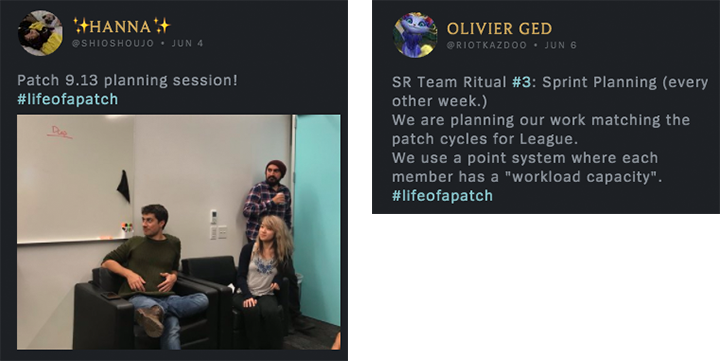
When choosing which medium-sized things to work on, we usually ask (in this order)…
- Is there anything the game really needs right now that can’t be fixed with a simple change and that will need a fair amount of playtesting to validate?
- Is there any carry-over work we want to continue?
- Is there anything the game needs that we can finish in 6-8 weeks?
These decisions are made using a pretty wide view of League’s gameplay, taking into account data from all skill levels and pro play globally and the team’s shared understanding of the current state of League.
After asking these questions for 9.13, we chose to focus on: Swain, Rod of Ages, solo lane Pyke, Udyr, Illaoi, Mordekaiser (potential hotfixes), and preseason changes.
Choosing the Direction
Now it’s time to figure out how we want to meet the goals for each of these things. This sounds simple, but it usually takes the most time. As we gather feedback from players, data analysts, quality analysts, and other designers, the change lists are constantly updated.
One way we can quickly get input from the rest of the team is by going to “Lightning Talks,” which we hold every other day. In this meeting, designers share their proposed changes with the room, and the rest of the team shares their thoughts, ideas, and concerns with the approach. Since it’s easy for a room of designers to talk in-depth about every change, we set a four-minute timer for each topic. After four minutes, we quickly vote on whether we should keep discussing it or move on.
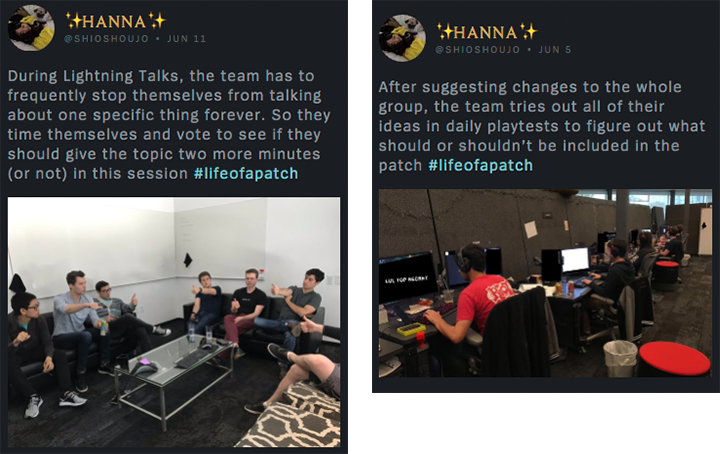
In addition to these meetings, the entire Summoner’s Rift team (including data analysts, engineers, and managers) runs and participates in playtests twice a day. This helps them get an idea of how the changes actually feel in the game. There’s also an entire team of high-Elo quality analysts who run their own playtests each day and provide designers with additional feedback on whether the changes meet their intended goals. Playtests can also be the time for some friendly and totally professional BM.
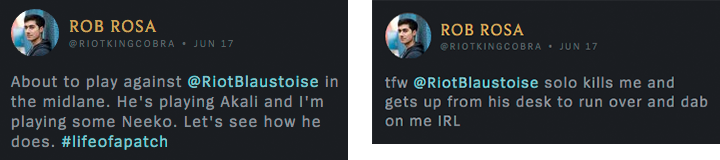
If you’re curious, here’s what some of the balance changes for 9.13 looked like from the beginning of Sprint Planning to the end of the patch cycle.
A New Challenger!
The Summoner’s Rift team sometimes partners with the Champions team on larger champion changes—stuff that’s more in-depth than a typical buff or nerf, but much smaller than an update (Aatrox’s changes in patch 9.9 are a good example). This might happen if a champion’s problems aren’t really solvable with numerical or quality-of-life changes. In these cases, there are often many viable ways to address the issues, and it’s impossible to know which one’s best until we explore them. This is why these types of changes usually take more than a few weeks.
In patch 9.13, RiotRepertoir started putting some long-term thought into Akali.
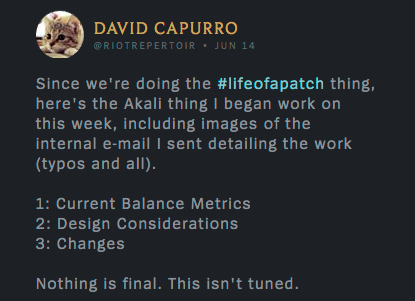
Check out this Tweet for the full email, this one for Riot Blaustoise’s feedback, or this one for the current change list.
In the rare case that the team is able to lock-in a direction quickly, changes like this won’t make it into the next patch. There are League players all over the world that speak dozens of languages, so any changes that require us to update the in-game tooltip would likely be bumped, that way local teams have time to translate.
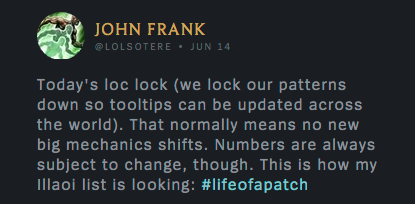
The Illaoi changes are already live, but if you’re curious, you can find the full list here.
Please Buff My Champion
Towards the very end of a patch cycle, we start on the sometimes-contentious part of balance work: champion buffs and nerfs. Deciding simple buffs and nerfs at the end of a patch cycle means we get to gather as much data as possible from the previous patch, which will have been live for about five days.
Once every two weeks, the team gets together in a “State of the Game” meeting, where we pull the data from the live patch and see which champions are on the chopping block (or buffing block?). The team determines which champions to change using their recently-defined data thresholds that take all of the guesswork out of who to buff and nerf—this ensures we’re being objective about a champion’s power level across all skill levels, and it prevents any champions from sliding under the radar.
Here’s a reminder of what those thresholds look like:
| Level of Play | Nerf if ANY are true | Buff if ALL are true |
| Average Gold1 and below | >54.5% win rate while ban rate is below the ABR DOWN TO >52.5% win rate while ban rate is above 5x the ABR | <49% win rate |
| Skilled Plat4 to Grandmaster | >54% win rate while ban rate is below the ABR DOWN TO >52% win rate while ban rate is above 5x the ABR | <49% win rate |
| Elite Challenger | >45% ban rate | <5% presence |
| Pro Top 5 Pro Regions | >90% presence on current patch OR >80% average presence across 2 consecutive patches | <5% presence |
Here’s what the data showed for patch 9.12:
Based on this, the champions and items up for buffs and nerfs for 9.13 were…
Buffs:
- Sylas
- Syndra
- Ornn
- Tristana
- Randuin’s Omen
Nerfs:
- Sivir
- Karma
- Sona
- Sejuani
- Essence Reaver
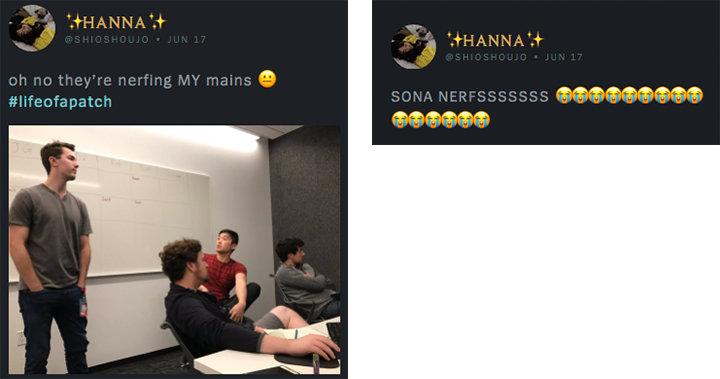
The feel when you meme players about nerfing their champions and your main gets nerfed next patch.
While the data helps us to be objective in most cases, there are instances where the team uses their collective experience to subjectively change something even if the data doesn’t directly tell them to. In this patch, the prime example was Sona. She’s been highly present in all skill brackets, but not high enough on the other thresholds to warrant a direct nerf. However, the team felt that the playstyle she enabled was not healthy for the game and worth changing outside of the data.
When it comes to items like Randuin’s and Essence Reaver, we don’t necessarily have as much data to inform our decisions. Most of the time, items are changed based on the experience and observations made by the team. Afterall, a part of the balance team’s job is to make decisions based off the knowledge they have of the game and their awareness of the status of the meta at any given moment.
In this case, we nerfed Essence Reaver because after a few incremental buffs, and with the new Infinity Edge/Essence Reaver build paired with Lethal Tempo, its performance was slightly higher than we thought sustainable.
We decided to buff Randuin’s Omen because its effectiveness felt low in a game state where it should feel powerful, namely as a good response to crit itemization. Tanks also aren’t currently a dominant part of the meta, so we felt like there was some room to buff Randuin’s.
Please Buff My Champion a Lot
Once we know which champions (and items) to buff and nerf, we have to decide how to do it.
We tend to approach nerfs by asking, “What problem is this champion exhibiting,” or, “Is their weakness not good enough?” Sejuani is an example of a champion who crossed the threshold for just pro play, which meant we specifically wanted to target a reason why pros were valuing her. Pros were rushing Warmog’s early, so we nerfed her HP growth per level, which should slow down the way pros are using that strategy but be less significant to solo queue power. (In general, pros don’t really respond much to base stat changes, but they will respond to a change to the thing they’re valuing about a champion.)

For buffs, we tend to ask, “Which audience is this champion most underperforming for?” Generally if a champion is getting a buff, they have a low-to-average performance across the board, but they tend to be struggling more in certain skill brackets. Syndra is a great example of this—she’s usable in pro play, but she’s pretty lacking in solo queue. We know Syndra can be a meta driver, especially at the pro level, so we didn’t go too hard on the buff. We targeted her mana growth per level in an attempt to make her more viable across all skill brackets, especially where players are more likely to run into mana issues.
When we decide to buff or nerf a champion, we also set a target for how much we want their solo queue win rate to change. (If we nerf something because of pro play, the only goal is to stop them from tipping the threshold.) So for example, with Syndra we aimed for about a .5% to 1% bump, which is another reason we targeted her mana growth stat—it generally has a somewhat small impact on winrate.
On the flip side, if we wanted to have a bigger impact on a champion’s win rate (>2%), we know that a little early game power goes a long way for solo queue performance. So for example, deducting 3 AD from an ADC may be a pretty meaningful power decrease. Similarly, decreasing the base damage on the early ranks of spells tends to have a bigger impact on their win rate, whereas reducing damage on later ranks or spells that are ranked later has a lighter effect.
Then What Happens?
The patch goes live… almost. Next we write the Patch Notes, where we compile all the changes and the context around ‘em in one place, then we send that off to all the regions to translate. We get the patch ready to deploy, take down the servers for a bit, hit the big green go button, and the patch goes live!
And by that point, we’ve already started the whole thing over again.